2026 Election Resources for Catholics in Michigan

This website is intended to help Catholics in Michigan who are preparing to vote in the 2026 statewide primary and general elections.

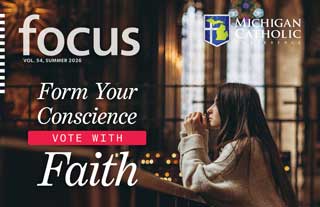
Form Your Conscience, Vote with Faith

This edition of Focus encourages Catholics to embrace the call to faithful citizenship in this year’s election in Michigan.

To Form Your Conscience is to develop, with the support of Sacred Scripture and the teachings of the Church, the capacity to recognize the moral quality of a particular action.

To Vote with Faith is when believers apply a well-formed conscience rooted in Church teaching and Scripture to the act of selecting candidates for public office.

Front cover of the print edition of ‘Form Your Conscience, Vote With Faith’

MCC Urges Catholics to Vote No on Proposal 1 this November

To protect Michigan’s constitution from being rewritten by out-of-state actors and interests, Michigan Catholic Conference is encouraging a no vote on the Proposal 1 ballot question this November, which will ask voters if a constitutional convention should be convened.

MCC Joins Coalition to Oppose Proposal 1

MCC Joins Statewide Coalition to Oppose Constitutional Convention Question Following Unanimous Board Decision

The interior of the Michigan State Capitol Building dome

Following a unanimous decision from the Michigan Catholic Conference Board of Directors, MCC is encouraging a no vote on the Proposal 1 ballot question this November, which will ask voters if a constitutional convention should be convened.

Prayer & Conscience Formation Resources

For faith to inform one’s participation in civic life, forming a Catholic conscience becomes an important first step.

Forming Consciences for Faithful Citizenship Prayer

Merciful Father, thank you for inviting each of us to join in your work of building the kingdom of love, justice, and peace.

Draw us close to you in prayer as we discern your call in our families and communities.

Send us forth to encounter all whom you love: those not yet born, those in poverty, those in need of welcome.

Inspire us to respond to the call to faithful citizenship, during election season and beyond.

Help us to imitate your charity and compassion and to serve as models of loving dialogue.

Teach us to treat others with respect, even when we disagree, and seek to share your love and mercy.

We ask this through Jesus Christ our Lord, who lives and reigns with you in the unity of the Holy Spirit, one God forever and ever. Amen.

Conscience Formation Resources

A Catholic examination of conscience prior to voting

U.S. bishops’ teaching on ‘intrinsic evils’ and what it means for voting choices

From conscience to concrete action: How Catholic social teaching illuminates the issues

Catholic social teaching flows from the same authority and Tradition as its teachings on faith and morals. A conscience formed by these teachings provides a cohesive and consistent perspective on current issues, where political choices are guided by faith, rather than by partisan stances.

The following principles are useful to help Catholic voters understand current public policy issues through the lens of Church teaching.

Tips for Evaluating Candidates

Voting as a faithful citizen not only involves conscience formation in accordance with Church teachings, but also evaluation of the candidates ahead of voting.

How can a faithful citizen engage in research of candidates? In Michigan, every registered voter can view the candidates for the upcoming election on his or her ballot via the Michigan Voter Information Center.

The following list provides a few suggestions for researching candidates. Keep in mind that no single source will provide the most complete picture—or even the most accurate picture—of a candidate’s qualifications and his or her positions on the issues.

Candidate Websites

Most candidates will have a campaign website where they will list their positions on the issues. In many cases, candidates will clearly state what positions they favor or oppose on the most common policy issues. However, it can sometimes be difficult to get a clear answer on these positions depending on the amount of detail they provide. Also, the issues they list may not be categorized the same way the Church categorizes social issues.

Voting Records

For incumbent officials running for re-election, their voting record on legislation can provide a clearer picture of where they stand on the issues. For incumbent Michigan legislators, the site MichiganVotes allows voters to search for their lawmakers and view their votes on bills that came before the state Legislature. For Michigan’s congressional members, the site voteview provides a similar service. The amount of information and what kind of information provided about the legislation can vary depending on the site and the bill.

Local News Sources

Local news outlets will sometimes profile candidates running for office as part of their campaign coverage. News outlets will also sometimes request candidates fill out questionnaires with their positions on the issues, which the outlet will then publish. Newspaper editorial boards also issue endorsements of certain candidates, which may provide more information. However, these endorsements will also include commentary from the editorial board staff on the candidate, which should be differentiated from objective facts about and positions held by the candidate.

Campaign Finance Records

Where political candidates draw their financial support from can factor into understanding the interests they hold. For state-based candidates, the Michigan Secretary of State provides an online platform that is searchable by the candidate’s name. For Michigan candidates running for Congress, the Federal Election Commission provides similar search tools. In either case, reviewing the individuals and groups that contribute funding to a candidate can provide some context about where the candidate’s interests lie.

Candidate Social Media

The U.S. bishops teach that Catholics should consider a candidate’s commitments, character, and integrity when discerning their choices for voting. One way to evaluate this is by checking a candidate’s social media profiles. Most candidates have active social media accounts on major platforms, and some may have both a personal account and a campaign account, as well as an account affiliated with their official office if he or she is already elected. Reviewing how a candidate conducts his or herself on social media could be helpful in assessing their character and integrity, in addition to any statements they may make regarding their positions on the issues.

Why Catholics should be “media mindful” when evaluating political information

Being “media mindful” is a concept coined by the Daughters of St. Paul, a religious order of sisters who call themselves the “Media Nuns” and have made promoting digital literacy to Catholics their mission. Being media mindful means constantly asking questions of information.

Voting Information

September 24
Absentee voter ballots available for voters
October 19
Last day to register to vote by mail or online
New voter registrations are required in person after this date
October 24
Constitutionally-mandated early voting period begins
November 1
Constitutionally-mandated early voting period ends
November 3
Statewide general election

Modeling Faithful Citizenship in the Family

The most important place to share and reflect on Catholics’ call to be faithful citizens is in the family. Just as parents are the first educators of their children and are responsible for handing on the faith, civic responsibility starts with the adults in the family.

Using MCC’s election-related Focus publication and other resources provided by the bishop’s office or MCC, here’s how you can model faithful citizenship in the home:

Incorporate faithful citizenship into prayer.

Point out to your children that the intentions prayed in Mass will often include prayers for civic leaders. Teach your children to pray for the country, the state, and your hometown. Lead a Novena for Faithful Citizenship in the nine days prior to the election.

Show your children that you are interested and engaged in the issues discussed in Focus.

Express your beliefs about these issues, their connection to Catholic social teaching, and share questions you have about issues or candidates. Look for opportunities to state where the Church stands on a certain issue or why you favor a certain candidate.

Ask for your children’s opinions, questions, or concerns related to the issues discussed in Focus.

Be genuine with your interest, and really listen to what they have to say. Don’t worry if they don’t agree with your position or even with all the positions expressed in Focus.

Show that you truly respect different points of view on the issues or candidates, and that good people can disagree on specific matters without hostility.

Use campaign advertisements as an opportunity to start discussions.

Look at billboards and television advertisements for various candidates and critique the advertisements as a family. Do the candidates address any of the issues mentioned in Focus? How well?

Get involved yourself.

Consider attending a neighborhood association or local government meeting to hear about matters that impact your immediate community. Tell your children about the experience. Look for social activities that your whole family could get involved in, such as a pro-life march or an environmental cleanup project, for example.

Vote and let your children know that you see voting as a priority.

Bring your children with you to the polls. Discuss the election returns together and gently talk about their implications.

This resource was adapted from a similar document provided by the USCCB, which includes more on tips for applying faithful citizenship in the family.

Faithful Citizenship Parish Presentations

During election years, MCC staff often give talks to local parishes across Michigan on faithful citizenship. These interactive sessions share practical tips about forming a Catholic conscience, evaluating candidates and the issues, and how to prayerfully prepare for elections and vote as Catholics.

See below a list of the dates, times, and locations of the talks that have been confirmed at this point. More information about the particular events—including the exact location of where the talk takes place at each parish—may be available by contacting the host parish.

Tuesday, October 13 at 7 pm
St. Mary Magdalen Parish in Brighton
Monday, October 19 at 6:30 pm
MCC Webinar on Zoom
Register
Wednesday, October 21 at 6:30 pm
St. James the Greater in Houghton Lake
Tuesday, October 27 at 6:30 pm
St. Thomas the Apostle Parish in Grand Rapids
Thursday, October 29 at 7 pm
St. Mary Parish in Williamston