Michigan should officially opt into the new federal policy, which would make substantial financial support available to public and nonpublic school families facing out-of-pocket education expenses, without impacting the state School Aid Fund.
MCC announced that Bill Stone has joined the organization as Vice President for Public Policy and Advocacy, beginning today February 23. Stone will be responsible for guiding the organization’s advocacy work and will serve as the primary liaison between state government and the Catholic church in Michigan.
Ensuring families and children in need do not go without food is a pressing policy priority, Michigan Catholic Conference said today in supporting the state Senate’s approval of funding intended to cover the cost of federally funded food assistance scheduled to stop this weekend.
The budget enacted for the current 2025–2026 Fiscal Year makes significant investments in protecting and feeding school children, regardless of where they attend school, and improving the economic stability of pregnant mothers and families with newborns in Michigan, all of which are important MCC policy priorities.
MCC president and CEO Paul A. Long today offered comments regarding the death of Most Rev. Carl F. Mengeling, bishop emeritus of the Diocese of Lansing, who passed into eternal life July 1, 2025.
Lansing Update publishes on Fridays when the Michigan Legislature is in session and chronicles legislative activity of interest to Michigan Catholic Conference.
MCC is offering support to legislation to improve access to and preserve affordable housing, which responds to the need for more housing in Michigan, and is aligned with the Catholic principle of promoting a preferential option for the poor.
The House and Senate both approved budget proposals for next year that fund many MCC priorities, with the House education budget in particular funding all MCC requests for supporting nonpublic schools, from school safety to teacher recruitment programs and more.
MCC offered support for legislation requiring the state and schools to distribute information about sextortion, and worked to ensure nonpublic and Catholic schools have access to the information to prevent against this new form of child exploitation. Also, MCC stands against allowing businesses to charge high interest rates, and a plug for participating in Holy Week.
The Governor gave her final State of the State, and MCC provided support for legislation to limit children from accessing AI chatbots that mimic human relationships. Plus, an encouraging report on the number of Michiganders who are expected to become Catholic this Easter.
The process to pass the next state budget began this week. Read more on the Governor’s proposals regarding MCC priorities such as nonpublic schools and helping mothers and children. Plus, MCC offered support to improve education choice for public school parents, and more.
The Word from Lansing is a regular column written by Michigan Catholic Conference (MCC) staff for Catholic news outlets. Through these columns, MCC outlines current advocacy issues of importance to the Conference and discusses the Catholic position and role in the political process. This publication complements the more regular updates provided by Michigan Catholic Conference’s Catholic Advocacy Network.
Michigan families of both public and nonpublic students could soon apply for and receive funding to pay for out-of-pocket education expenses under a federal education tax credit program. The state of Michigan must formally opt into the program for families and students to benefit.
Protecting children from harm while nurturing their growth is a goal both parents and policymakers often share, a goal aligned with the Church’s concern for families and children. This is why Michigan Catholic Conference has recently offered support to legislation limiting children’s access to artificial intelligence companion chatbots and addictive social media feeds.
As the process for a new state budget begins, MCC shares how its advocacy efforts last year played a critical role in securing the support Catholic and nonpublic schools received in the current year budget.
The Christian faith demands more than just lip service; it requires action. The principles of Catholic social teaching show us what that action looks like; they also help us to engage more deeply with Jesus’s instruction to “love thy neighbor.”
In commentary on the most recent state budget, MCC explains that a nearly $300 million investment into helping mothers in need is one tangible way public officials can walk the talk of supporting life at every stage.
Focus is MCC’s quarterly publication that examines a social or public policy issue through the lens of Catholic social teaching. Focus has a mailing list of 4,200 and typically distributes 50,000–75,000 copies to Catholic institutions across the state.
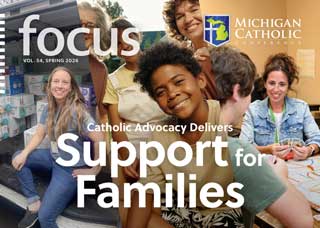
In its public policy advocacy on behalf of the Church, MCC works to secure funding in the state budget to support the Church’s ministries that serve Michigan families and children in need. The new edition of Focus shares specific examples of how state funding secured by MCC helped programs that assist families in need of diapers, parents seeking to adopt and foster children, and homeless and runaway youth in crisis.
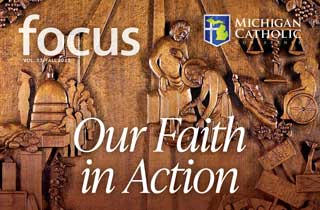
As members of the body of Christ, we are each called to live out the Gospel not only in words, but in action. Catholic social teaching provides a blueprint for how we put our faith into action. This edition of focus presents the seven themes of Catholic social teaching and invites Catholics reflect on how they can incorporate these principles into their lives, so as to more actively proclaim the Good News of Jesus Christ both in word and deed.
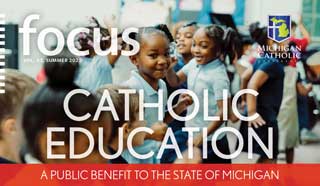
This edition of Focus looks at how Catholic schools serve a diverse population of students and families, transforming lives by forming children into virtuous members of society. Rich or poor, Catholic or non-Catholic, and children of all learning abilities are welcomed into Catholic schools across Michigan, primarily due to the Church’s efforts to make Catholic education financially feasible to those who want it, and despite constitutional restrictions on public aid for nonpublic schools.
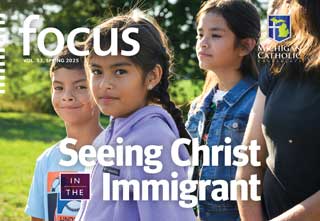
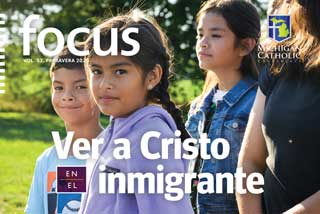
How should Catholics think about immigration and the migrants who land here? This edition of Focus shares how the Church’s perspective on immigration is guided by the fundamental Catholic social doctrines of upholding human dignity and caring for the poor and vulnerable. This publication features the stories of immigrants who have traveled to Michigan, explains why and how the Church serves migrants, and answers frequently-asked questions about Church teachings on immigration.
The Advocacy Reports are published at the conclusion of each two-year legislative session and summarize MCC’s public policy and communication advocacy work across the nine advocacy principles that guide MCC’s involvement in legislative issues.
Over the course of the 2019–2020 state legislative session, Michigan Catholic Conference (MCC) worked diligently with lawmakers and legislative staff of both political parties to advance the common good. In a February report, MCC details its advocacy work from the past two years and highlights critical legislative achievements for Michiganders, especially those that recognize the dignity of the human person and address the needs of the vulnerable.