
Lansing Update: MCC Highlights Education Advocacy During Catholic Schools Week
Posted January 30, 2026
Proclaiming The Public Benefit of Catholic Education During Catholic Schools Week
This past week marked Catholic Schools Week, the annual opportunity for the whole Church to promote Catholic education and its tremendous impact in the lives of students, families, and local communities.
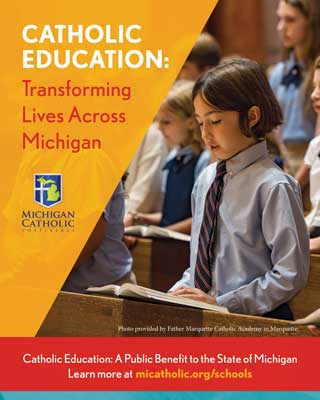
To join in this promotion of Catholic education as a public good, Michigan Catholic Conference published an edition of Focus that rightly recognized Catholic schools as a public benefit to this state. The publication was directed toward addressing common misperceptions held by some, including those who mistakenly think Catholic schools are only open to Catholic students or to the wealthy.
Through the stories of educators and students from across Michigan, the Focus package shows how Catholic schools serve the common good through rigorous academics while striving to be accessible and affordable to families of all backgrounds.
Focus was distributed in print to Catholic parishes and schools, as well as to public policymakers and state officials as part of an ongoing effort to improve public perception and support of Catholic education. Print copies of Focus—which could be helpful for Catholic school promotion and marketing—are available free of charge by placing an order with MCC, and the digital edition is available at micatholic.org/schools.
MCC works to support Catholic education year-round through public policy advocacy at the Capitol, including securing state funding for services intended to benefit all students, such as school safety and healthy meals.
In the current state budget, Catholic and other nonpublic schools have access to $21 million in funding for school security upgrades, school resource officers, and improved mental health services. MCC also successfully secured funding to ensure eligible nonpublic schools can offer breakfast and lunch to all students regardless of family income.
In addition to the budgetary support, state lawmakers in both the House and Senate recently adopted resolutions providing formal recognition of Catholic schools.
The resolution text, noting that “the common good of the state of Michigan is strengthened through the continued existence of Catholic schools,” presents statistics regarding the impact of Catholic schools in Michigan, including:
- There are 50,421 students attending 207 Catholic elementary and high schools.
- Catholic schools will save taxpayers more than $506 million in state spending during the current school year, based on the state’s minimum public school foundation allowance of $10,050 per pupil.
The House resolution, HR 236, was offered by Rep. Kathy Schmaltz (R-Jackson). The Senate Resolution, SR 89, was offered by Sen. Joe Bellino (R-Monroe).
MCC-Backed Bills to Combat Human Trafficking Receive Unanimous Senate Support
Legislation supported by MCC to strengthen human trafficking penalties and better protect victims unanimously passed the Senate this week.
MCC supports Senate Bills 520 and 521, which makes a human trafficking violation that involves a minor and kidnapping, criminal sexual conduct, or death a felony punishable by up to life imprisonment and a maximum fine of $50,000.
The bills, sponsored by Sen. John Damoose (R-Harbor Springs), increase this penalty from the current maximum of 20 years’ imprisonment.
A third bill in the package, Senate Bill 705, is sponsored by Sen. Sue Shink (D-Dexter) and strengthens protections for minors who are human trafficking victims by providing a presumption that minor victims of trafficking are coerced into committing criminal offenses.
The legislation heads next to the House for further consideration.
The month of January is also National Human Trafficking Prevention Month, which is intended to promote awareness of the prevalence of human trafficking. The Senate adopted a resolution to mark the occasion and note that “human trafficking, whether in the form of sex trafficking or forced labor is a threat to global security, public safety, freedom, and human dignity.”
Senate Resolution 90 was also sponsored by Sen. Shink.
Coming Soon: New Budget Proposal & State of the State Address
The beginning of the calendar year in Lansing is marked by two important dates: The proposal of a new executive recommendation for the next state budget, and the annual State of the State address, both of which are provided by the Governor.
The Governor’s budget proposal will be formally presented to lawmakers and the public Feb. 11. MCC will review the budget proposal and provide commentary on items of interest, including those that affect nonpublic schools, programs that help mothers in need, and initiatives that serve the poor and vulnerable.
The executive budget proposal begins the budget-setting process for Fiscal Year 2027, after which the House and Senate will propose and pass their own spending plans.
The State of the State address is scheduled for Wednesday, Feb. 25. It will be the final address given by Gov. Whitmer, whose second and final gubernatorial term ends at the conclusion of 2026. MCC may provide commentary on any applicable public policy proposals mentioned in the speech.
Both the House and Senate are scheduled for regular session days throughout most of February and March, with the next major session break for both chambers set for late March and early April around Easter.
Revisiting MCC’s Population Growth Proposal After New Census Report
This week, the topic of Michigan population growth was in the news again upon the release of new Census data. The population figures indicated that Michigan did grow in population from 2024 to 2025, but ever so slightly—0.3%.
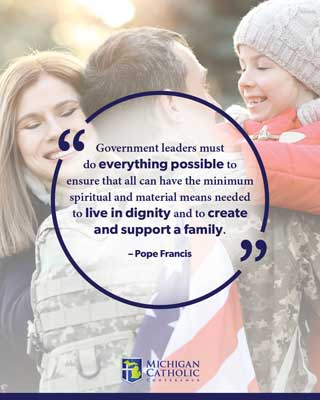
A few years ago, the state’s long-standing population stagnation was a point of conversation among public officials. Gov. Whitmer convened a task force to study the issue and propose solutions, and MCC took the opportunity during the public input period to provide perspectives grounded in Catholic teaching on marriage and family.
MCC shared that policymakers should view proposed solutions through the lens of supporting family life by making it easier to have and raise children in this state. MCC particularly made note of the state's low birth rate and recommended consideration of policies that help Michigan’s lower-income residents afford the opportunity to start and raise families.
“As part of the Council’s goal to recommend policies that grow the population, our state should pursue measures that assist parents—or those who want to become parents—who are facing difficult economic circumstances,” wrote Paul A. Long, president and CEO of MCC, in the letter presented to the population panel. “By creating a strong culture of support for parents who need assistance with food, housing, childcare, health insurance, material necessities for children, or even finding a job, Michigan should be a place where people can see themselves raising a family, no matter their circumstance.”
Read more about MCC’s advocacy before the state’s population growth panel here.
Pray A Holy Hour for Peace in Our Country
Bishops and priests are encouraged to offer—and lay Catholics to participate in—a Holy Hour for Peace, amidst “the current climate of fear and polarization” in the country.
The exhortation to pray a Holy Hour for Peace was offered by the president of the U.S. Conference of Catholic Bishops (USCCB) in response to recent “tragic examples of the violence that represent failures in our society to respect the dignity of every human life,” including the “recent killing of two people by immigration enforcement officers in Minneapolis and that of a detained man in Texas.”
“Let us pray for reconciliation where there is division, for justice where there are violations of fundamental rights, and for consolation for all who feel overwhelmed by fear or loss,” said Archbishop Paul S. Coakley, president of USCCB, in a statement this week.
For prayers and readings associated with a Holy Hour for Peace, click or tap here.