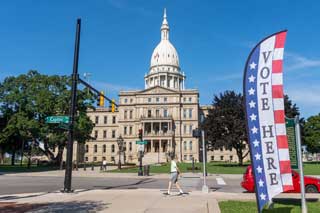
Catholics have a particular call to engage in elections, first by forming their consciences according to the teachings of the Church founded by Jesus Christ, followed by prayerfully and intentionally evaluating the candidates and the issues before casting a vote.
In short, to be a faithful citizen means to Form Your Conscience and to Vote with Faith.
To Form Your Conscience is to develop, with the support of Sacred Scripture and the teachings of the Church, the capacity to recognize the moral quality of a particular action.
To Vote with Faith is when believers apply a well-formed conscience rooted in Church teaching and Scripture to the act of selecting candidates for public office.
Faithful citizenship guides Catholics and others of goodwill to promote the common good, where all in society may thrive and reach their God-given potential. To place one’s faith above partisan and political criteria is to acknowledge that faith and not a political party or candidate is at the heart of developing one’s conscience.
Jesus calls His followers to be salt, light, and leaven in the world. This edition of focus encourages Catholics to embrace the call to faithful citizenship in this year’s election. When Catholics allow the truths of Church teachings to form their voting decisions, they can more fully be the salt, light, and leaven that our state needs.
Prior to voting, Catholics are called to form their conscience in accordance with Church teaching.
This begins with living a life rooted in Prayer,Scripture,Sacraments, and Study. Ahead of researching the candidates and learning the issues, consider the following:
Prayer: How often do I pray? How might the Lord be calling me to deepen my prayer life with Him?
Scripture: How often do I pray with or read Sacred Scripture? How might the Lord be calling me to spend more time with His Word?
Sacraments: How often do I frequent the Sacraments? How might the Lord be calling me to encounter Him more often in the Sacraments, particularly in Holy Communion and Confession?
Study: In what ways do I seek to grow in my understanding of the Catholic faith and what I profess to believe? How might the Lord be calling me to deepen my understanding of the faith, and in what ways can I do that?
From conscience to concrete action: How Catholic social teaching illuminates the issues
Forming one’s conscience includes understanding and embracing the Church’s social doctrine. Catholic social teaching flows from the same authority and Tradition as its teachings on faith and morals. It offers a refreshing, hope-filled perspective on current affairs because it is founded on God.
The themes presented in Catholic social teaching, originating in Scripture and further articulated through Church Tradition, are represented across the nine advocacy principles that guide Michigan Catholic Conference’s public policy advocacy. These principles are useful to help Catholic voters understand current public policy issues through the lens of Church teaching.
Upholding the dignity of human life
Providing for the poor and vulnerable
Welcoming immigrants and refugees
Protecting religious liberty
Supporting students, schools, and parents
Strengthening marriages and families
Improving access to healthcare
Pursuing restorative justice
Caring for creation and preserving natural resources
Catholic voters should evaluate the extent to which candidates promote these principles, with a particular emphasis on the protection of human life and the dignity that must be afforded to all people, especially those on the margins or are otherwise vulnerable in our society.
To learn more about the nine advocacy principles listed above, visit cthl.cc/bftcg.
Catholics should take time to learn about the candidates and their stances on the issues.
The faithful will also benefit from being “media mindful” when considering the credibility of information.
Being “media mindful” is a concept coined by the Daughters of St. Paul, a religious order of sisters who call themselves the “Media Nuns” and have made promoting digital literacy to Catholics their mission. Being media mindful means asking questions about or verifying information and its source.
Sister Nancy Usselmann, FSP, director of the order’s Pauline Media Studies, said that an intentional approach to scrolling, reading, or viewing online media is important for Catholics because, “we have to live by our faith, values, and our virtues. We have to make that concrete in our everyday choices, our everyday engagement, and especially within our digital engagement.”
It is important to recognize that some platforms may not provide helpful political content, such as social media feeds. The algorithms developed by social media companies—which determine what users see on their news feeds—are driven by clicks, likes, and comments, making it more likely that sensational “clickbait” content will proliferate, Sister Nancy said.
Moving off the social media feed and evaluating candidate profiles—both their personal and campaign pages, if they have both—could be more beneficial when it comes to gleaning information from social media.
“By grouping people into bubbles of easy consensus and easy outrage, these [social media] algorithms reduce our ability to listen and think critically, and increase social polarization.”
Pope Leo XIV
Message for the 60th World Day of Social Communications, January 24, 2026
There is also an increased presence of bad actors who are deliberately trying to mislead and misinform with false content. Not only does fake content exist, but it is becoming more difficult to distinguish it from real content. This is particularly the case with information or images generated by artificial intelligence, which is very accessible and continuing to improve at quickly processing information and generating content.
However, it is still fallible technology. AI platforms are known to “hallucinate,” or make up information, Sister Nancy said, in addition to re-presenting inaccurate information as fact.
“As we scroll through our feeds, it becomes increasingly difficult to determine whether we are interacting with other human beings or with “bots” or “virtual influencers.” The less-than-transparent interventions of these automated agents influence public debates and people’s choices.”
Pope Leo XIV
Message for the 60th World Day of Social Communications, January 24, 2026
Being media mindful takes intentionality and thoughtfulness, which is challenging.
“We are often seeking the fast answer, the quick response, the instantaneous headline,” said Sister Nancy. “But if we want to truly live our Catholic faith within this political arena, we have to be better.”
Pope Leo XIV, in a message he shared regarding social communications and artificial intelligence, said, “it is increasingly urgent to introduce media, information and AI literacy into education systems at all levels.”
The Holy Father urged all stakeholders to be involved in “building and implementing informed and responsible digital citizenship.” That includes the everyday consumers of digital media, such as lay Catholics.
The tips offered by the Pauline Sisters to be media mindful are one path Catholics can take to practice responsible digital citizenship.
What’s at stake for Michigan in this election?
Federal
All 13 Michigan seats in the U.S. House of Representatives
An open race for one of the state’s two U.S. Senate seats
State
Open races for Governor, Attorney General, and Secretary of State
All 110 seats in the state House of Representatives
All 38 seats in the state Senate
Two seats on the Michigan Supreme Court
Numerous statewide education board positions
Local
Various county and municipal government positions
Judicial seats for regional and local courts
Board members for local school districts
Local ballot issues
Final words of encouragement
Catholics: Be salt, light, and leaven through your vote.
The Church cannot and will not tell you who to vote for.
Ultimately, those decisions are to be made after forming one’s conscience based on the teachings of the Church and prayerful reflection of candidate positions.
Any claim that Catholics “must” vote for this candidate or that candidate is merely a personal opinion rather than what the Church and the bishops teach the faithful about voting.
Voting as a faithful citizen includes prayer, research, and discernment. It is a thoughtful rather than a reflexive approach.
Remember: All believers are called to be salt, light, and leaven in the world, particularly when they allow the truths of the Catholic faith to form their voting decisions.
In closing, to slightly paraphrase the spiritual motto of St. Padre Pio: