
Lansing Update: Another win for nonpublic schools
Posted June 12, 2026
Nonpublic Schools Included in Bill to Enshrine Meal Program in State Law
Michigan’s nonpublic schools would be permanently included in the state’s universal school meal program under legislation that recently advanced from a state Senate committee on a bipartisan vote.

For the past several years, the state has been funding an expanded version of the federal breakfast and lunch program to cover all students, regardless of household income.
However, lawmakers had been excluding eligible nonpublic schools from funding, until this current budget year. State lawmakers approved funding for nonpublic schools for the first time since introducing the expanded program following years of persistent advocacy from Michigan Catholic Conference (MCC).
MCC has consistently shared that if the state’s universal meal program is to live up to its name, it should include students in nonpublic schools that would otherwise qualify, based on their participation in the federal breakfast and lunch program.
Senate Bills 784 and 785, sponsored by Sen. Dayna Polehanki (D-Livonia), were recently approved by the Senate Education Committee and would make the universal meals program a permanent part of state law. Lawmakers would still need to approve funding for the program in the budget each year, however.
Three years ago, similar legislation to make the school meals program permanent was proposed in the same Senate committee. Nonpublic schools were not included. MCC and the Michigan Association of Nonpublic Schools provided testimony about the inequities of leaving out nonpublic students. The legislation did not advance.
This year, the new version of the legislation to make the program permanent advanced to the full Senate and included nonpublic schools.
Lawmakers are currently working on next year’s budget, and both the House and Senate’s proposed budgets for the next fiscal year would continue funding school meals for nonpublic students.
The fact that lawmakers have included nonpublic students in funding for the meal program this year in addition to including nonpublic students in the bill to make the program permanent is a testament to MCC’s advocacy for nonpublic schools over several years.
Whether it is access to school meals, or school safety grants, or resources to install clean drinking water fountains, MCC works with state lawmakers to provide nonpublic students equitable access to state resources and programs to benefit the health and safety of students, regardless of the school they attend.
MCC Supports Bill Ensuring Parental Access to Children’s Medical Records
Parents would be guaranteed access to their children’s medical records under a MCC-backed bill that removes a provision in state law that has resulted in scenarios where parents are unable to access their children’s medical records without the child’s consent.
Current state law allows minors who “lawfully” receive health care without consent or notification of their parent, guardian, or parental figure to hold the “exclusive right” to access medical records related to that care. For example, minors on their own may consent to treatment for substance use disorders, sexually transmitted infections, and prenatal or pregnancy-related health care.
In most cases, the right to access and view medical records of a minor would belong to the parent, guardian or a person standing in as a parent, except for the scenario where a child receives certain care without a parent’s consent or notification.
House Bill 5974, sponsored by Rep. Joseph Aragona (R-Clinton Twp.), would remove that exception and ensure parents can access the medical records of their children regardless of the circumstances of the care received.
The legislation also stipulates that health providers cannot restrict the ability of the child’s parent or guardian to examine or obtain their child’s medical records.
MCC supports the update to state law to strengthen parents’ rights regarding the care of their children. Whether in education or in health care settings, MCC consistently supports legislation that protects parental rights and recognizes the responsibilities parents have in raising their children.
The legislation received a hearing in the House Health Policy Committee but has not yet advanced.
A Quick Guide for Busy Parents on the Federal Education Tax Credit
A few weeks ago, MCC announced its public support for the Federal Education Tax Credit and urged Michigan to opt in to the program, due to its potential impact to help more families afford out-of-pocket education expenses.
For more information about the tax credit and how it would benefit Michigan families, MCC prepared the following one-pager resource for parents of schoolchildren.
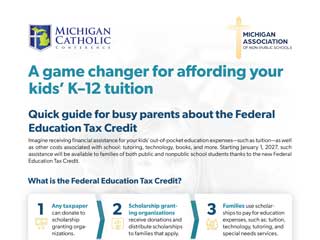
The purpose of the handout is to provide a quick, at-a-glance introduction to the policy, along with answers to frequently asked questions for those who want to learn more.
Feel free to share the document, particularly among families who have children in school.
Sex Ed & Gender Ideology in Public School Curriculum: What Parents Should Know
Last fall, Lansing Update readers may recall MCC was engaged in opposition to new state standards for public school health education due to their inclusion of sex education topics and promotion of gender ideology.
Because local school districts have already begun or will likely consider adopting the state health standards, MCC has prepared a one-page resource for distribution to Catholic parents of public school children.
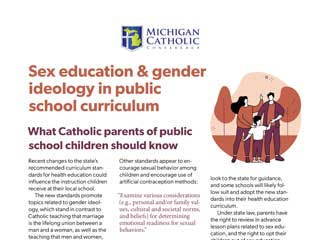
The purpose of the handout is to help parents understand their rights and how to address this issue if presented in their local school.
Feel free to share this with those who would benefit from the information, particularly Catholic parents of children in public K–12 schools.
The Pope’s Encyclical & MCC Advocacy Regarding Artificial Intelligence
As you may well be aware, Pope Leo XIV has published his first encyclical on the timely topic of artificial intelligence.
In addition to the document itself, the Vatican released a variety of resources to help the faithful engage with the Holy Father’s message, including an audio version of the document, a written summary and video recap, as well as other resources at this link.
When it comes to artificial intelligence and public policy, MCC is prepared to engage in “policies that address the potential benefits and threats posed by the utilization of artificial intelligence,” according to the most recent edition of the Blueprint for the Common Good, which is MCC’s public policy platform released every two years at the start of the legislative session.
During this recent session, MCC has weighed in on Michigan legislation pertaining to artificial intelligence, offering support to a bill that would prohibit technology companies from making AI-powered “companion chatbots” available to minors.
Even before his encyclical, the Pope had spoken about AI companion chatbots, noting that by imitating human emotions and simulating relationships, they are deceptive, including to the most vulnerable, which includes children.
Bishops Consecrate Nation to the Sacred Heart of Jesus
While the Church today celebrates the Solemnity of the Most Sacred Heart of Jesus, yesterday, the U.S. bishops formally consecrated the United States of America to the Sacred Heart of Jesus.

The bishops consecrated our country ahead of the 250th anniversary of the signing of the Declaration of Independence while at their annual spring assembly meeting in Orlando.
A replay of the livestream that took place Thursday can be found here.
Ahead of the consecration, Detroit Catholic published this explainer about what a consecration is.
For more information about this special historic event, including the rationale for the consecration, click or tap here.